Review tenders in minutes instead of hours
The Tender Analyzer reads complete tender documents, filters out the relevant line items and scores them against your service profile.
Why reviewing tenders is so expensive
The cost is not in the evaluation. It is in deciding what is relevant at all.
The starting point
- A tender holds hundreds to thousands of line items; only a fraction concerns your own trade.
- Whoever reviews it needs to judge professionally – which ties up exactly the people who should be pricing.
- Under time pressure it gets skimmed, and items go missing.
- Whatever was checked once is manual work again with the next tender.
What the tool takes on
- It reads the complete document, not a sample.
- Every item is scored against the stored service profile – with a reason.
- Quantities, standards and special conditions are recognised and returned in a structured form.
- The judgement stays with you: what you get is a pre-decision, not a commitment.
What the tool delivers
Not a data export, but a pre-decision you can work with.
A relevance filter for line items
Out of thousands of items, the ones matching your trade remain – with a reason for each.
An evaluation, not raw output
Quantities, standards and special conditions are recognised and returned in a structured form.
A match against your profile
The tool checks how close each item sits to your own service profile – a basis for bidding or declining.
From the document to an assessment
Four steps whose intermediate results stay inspectable.
- Ingestcommon formats directly
- Recognisestructure and quantities
- Scoreagainst your profile
- Returnstructured overview
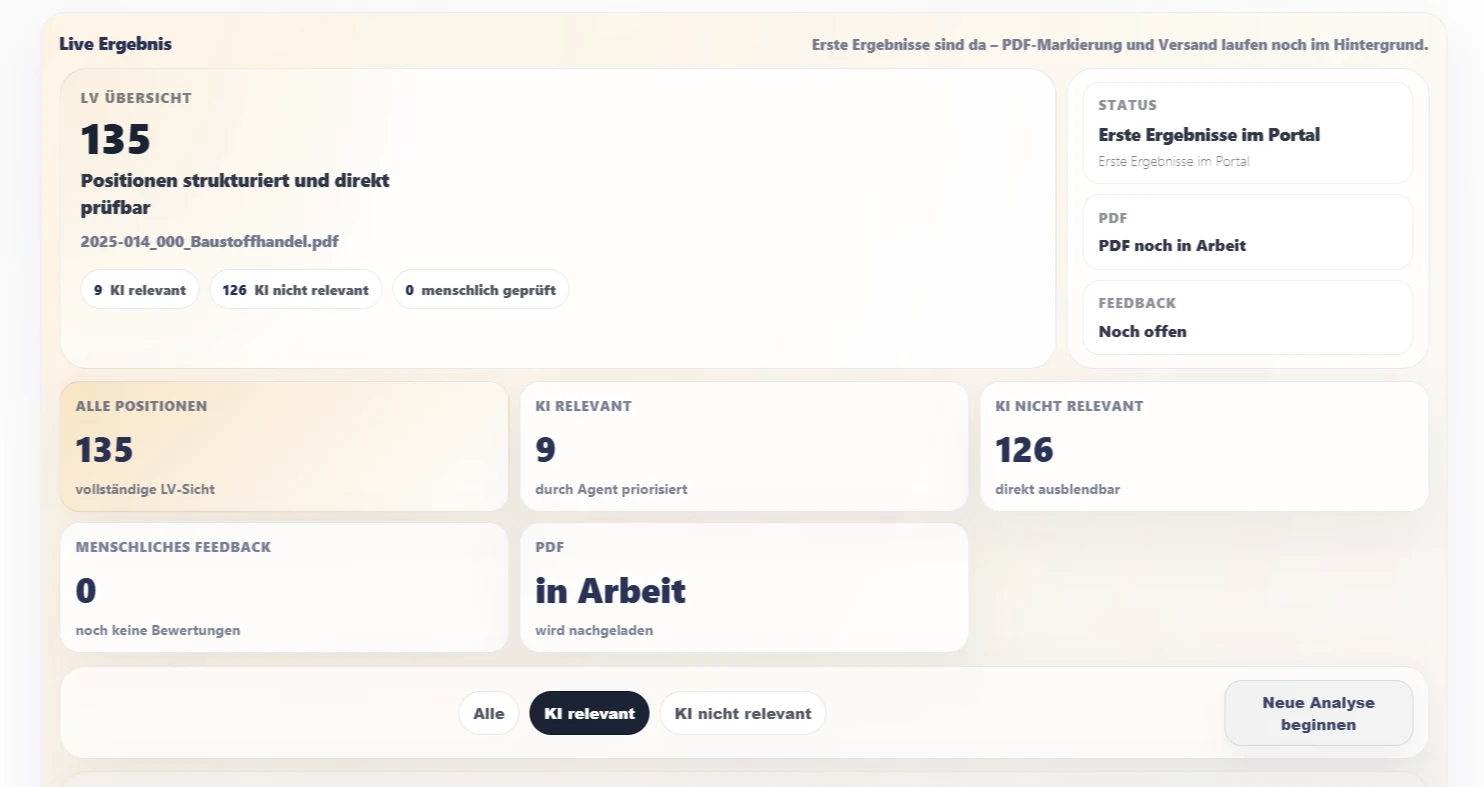
How an evaluation runs
From the document to an assessment you can act on.
Feed in the tender
Upload the file – the tool takes common formats directly.
Recognise the line items
Structure, quantities and content are read out and ordered.
Score the fit
Each item is checked against the stored profile on its merits.
Return the analysis
The result comes back as a structured overview, ready to use.
Where the tool reaches its limits
- A pure scan without a text layer gives worse results than a structured file.
- For a trade with no profile stored, there is no yardstick to score against – we set that up together beforehand.
- Pricing stays out of scope. The tool says what is relevant, not what it should cost.
Frequently asked
Which formats can be read?
The ones common in tendering. If a special format circulates at your company, we check it against a real file before anything is promised.
Does this replace the professional review?
No. It takes over the sifting and delivers a reasoned shortlist. Whether you bid remains your call.
How does the tool know what is relevant for us?
From your service profile, which we set up together and sharpen against real tenders.
Can we try it on one of our own documents?
Yes, and that is exactly how it should be judged. One tender from your daily work says more than any demo.
Are tenders eating your review time?
Then the tool is worth a look – with one of your real tender documents.